Competitive Intelligence
Ecommerce competitive intelligence for commerce technology vendors
What ecommerce competitive intelligence means when your competitors are commerce platforms, apps and services, not online stores, and how to run it on public evidence.
What is ecommerce competitive intelligence?
Ecommerce competitive intelligence is the structured practice of gathering and analysing information about competitors in the ecommerce market so a team can make better decisions. For a commerce technology vendor, such as a commerce platform, an ecommerce app or an agency, the competitors are other vendors selling to the same merchants.
Two meanings of the term
The phrase is often used for analysing online stores: their product assortment, prices and promotions. Vendors that sell to merchants need something different. Their questions are about how other vendors position themselves, which merchants they target and what they claim to offer.
| Analysing ecommerce brands | Vendor competitive intelligence | |
|---|---|---|
| Who is analysed | Online stores and retailers | Commerce platforms, apps, agencies and service providers |
| Typical questions | Prices, assortment, promotions | Positioning, ICP, products, published pricing, AI readiness |
| Typical users | Merchandising and pricing teams | Founders, product, marketing and sales teams at vendors |
| Typical sources | Product listings and price feeds | Vendor websites: product, solution, pricing and documentation pages |
CommerceInsights focuses on the second meaning: competitive intelligence for vendors that serve ecommerce merchants.
What to examine about a commerce technology competitor
- Company snapshot: what the vendor says it is and which category it claims.
- Ideal customer profile: which merchant segments, sizes and industries it addresses.
- Products and pricing: modules and published pricing. When pricing is not published, record it as not publicly disclosed rather than estimating.
- Positioning and SWOT: how it differentiates, and where strengths and gaps appear in the evidence.
- GEO readiness and AI visibility: how machine-readable its site is and how it appears in AI assistant answers at a given time.
- AI commerce capability: what it publicly claims about AI and agentic commerce support.
An evidence-based workflow
- 1Enter the competitor's website.
- 2Select up to 25 relevant pages, such as product, solution, pricing and documentation pages. Only these pages are used as evidence.
- 3Generate a report that separates observed facts, reasonable inferences and unknowns.
- 4Review the report with product, marketing and sales colleagues and note open questions.
- 5Re-run the analysis when you want an updated view and compare versions.
Limits to keep in mind
Public websites show what a vendor claims, not verified adoption, revenue or customer results. When the selected pages contain no evidence about something, treat it as unknown rather than absent. AI visibility results depend on prompts, models and timing, so they describe a snapshot rather than a permanent position.
Frequently asked questions
- Is ecommerce competitive intelligence the same as price monitoring?
- Not for commerce technology vendors. Price monitoring tracks retail product prices. Vendor competitive intelligence examines how competing vendors position, package and describe their offering.
- Which sources does CommerceInsights use?
- Only the public pages you select from the competitor's website. It does not use unselected pages or paid data providers.
- Does it reveal competitors' customers or revenue?
- No. It reports what the selected pages publicly state, and marks anything else as unknown.
- How often should we update competitive intelligence?
- Many teams review monthly or quarterly and re-run an analysis when a competitor makes a visible change, such as new positioning or pricing pages.
See it applied to a real vendor
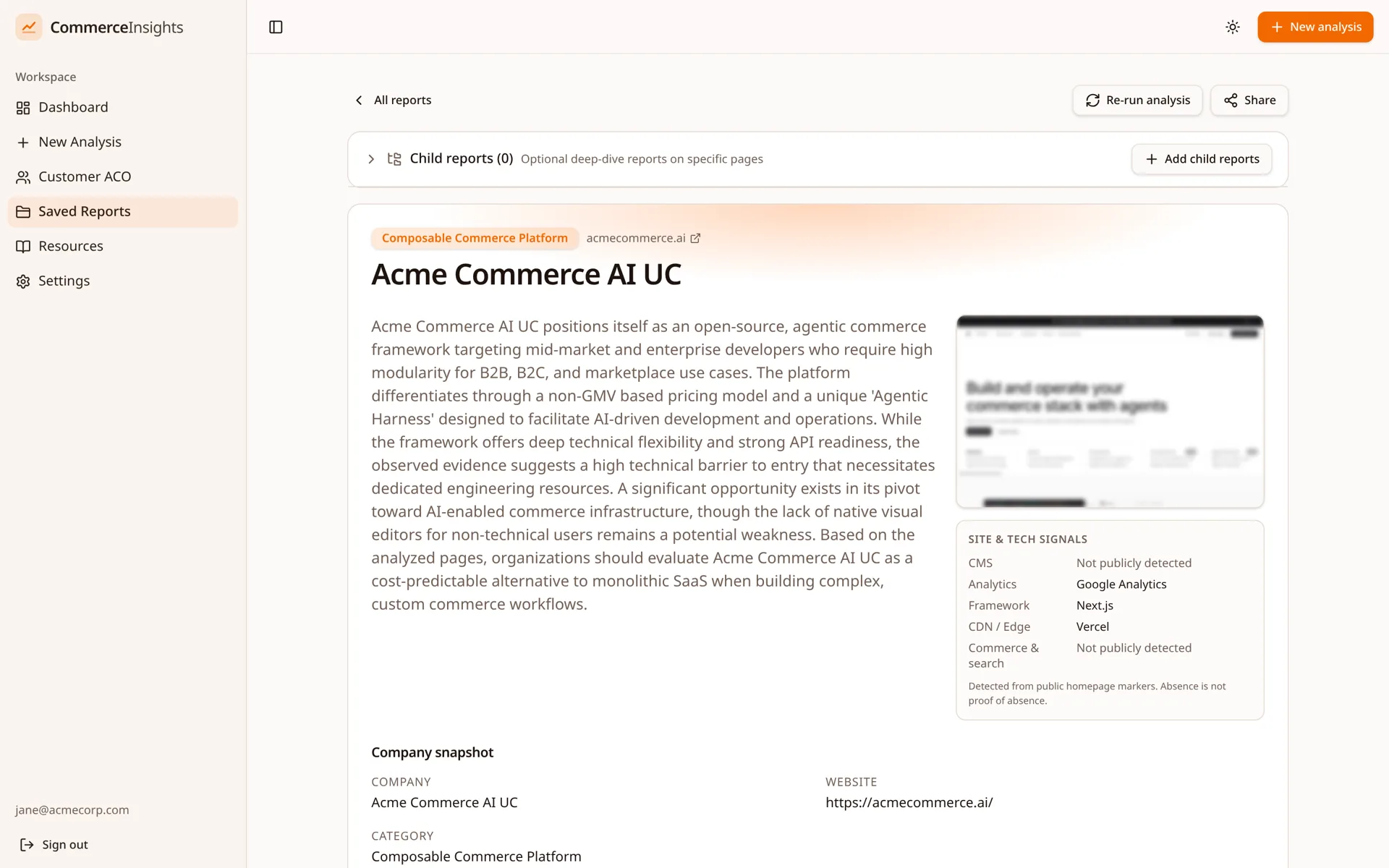
CommerceInsights generates a structured intelligence report for any commerce technology company in minutes.
Start free analysisRelated resources
Competitive Intelligence
What is Competitive Intelligence?
The difference between competitor research and competitive intelligence, how modern teams use it, and how CommerceInsights structures the workflow.
Read articleCompetitive Intelligence
Why Every Commerce Software Company Needs Competitive Intelligence in the AI Era
Why traditional competitor research is no longer enough, how AI has changed software buying, and what structured competitive intelligence looks like for commerce technology vendors.
Read articleAI Commerce Optimization
What is AI Commerce Optimization (ACO)?
A working definition of AI Commerce Optimization, why it matters as agentic commerce emerges, and how CommerceInsights scores vendor AI Commerce Capability.
Read article