Competitive Intelligence
What is Competitive Intelligence?
Competitive intelligence turns competitor research into structured, decision-ready insight for product, marketing, and executive teams.
What is competitive intelligence?
Competitive intelligence is the disciplined practice of gathering, analyzing, and distributing information about competitors and the market so an organization can make better decisions. It is not a one-off report — it is a repeatable workflow that turns public signals into strategic clarity.
Research vs intelligence
| Competitor research | Competitive intelligence | |
|---|---|---|
| Cadence | Ad hoc, project-based | Repeatable, structured |
| Output | Notes, slides, one-off documents | Structured reports and decisions |
| Consumer | The individual analyst | Product, marketing, sales, exec team |
| Question answered | "What does competitor X do?" | "How should we respond?" |
| Half-life | Days | Months, updated on a cadence |
Strategic decision making
Founders and executives use competitive intelligence to prioritize where to compete, where to differentiate, and where to yield. Structured, repeatable inputs make those decisions defensible and traceable.
Product management
- Track how competitors position their products and modules.
- Identify capability gaps and market opportunities.
- Support roadmap decisions with evidence rather than anecdote.
- Detect strategic shifts (pricing changes, new segments, repositioning).
Marketing
- Sharpen messaging by seeing how competitors describe the same category.
- Refine ICP and audience targeting.
- Ground category narratives in evidence.
- Spot narrative openings competitors have not claimed.
Sales enablement
- Objection handling based on real competitor claims.
- Vendor comparison sheets that reflect current competitor pages.
- Faster ramp time for new sellers.
The CommerceSpy workflow
- 1Enter the competitor website.
- 2Select the pages that matter (product, pricing, positioning, category).
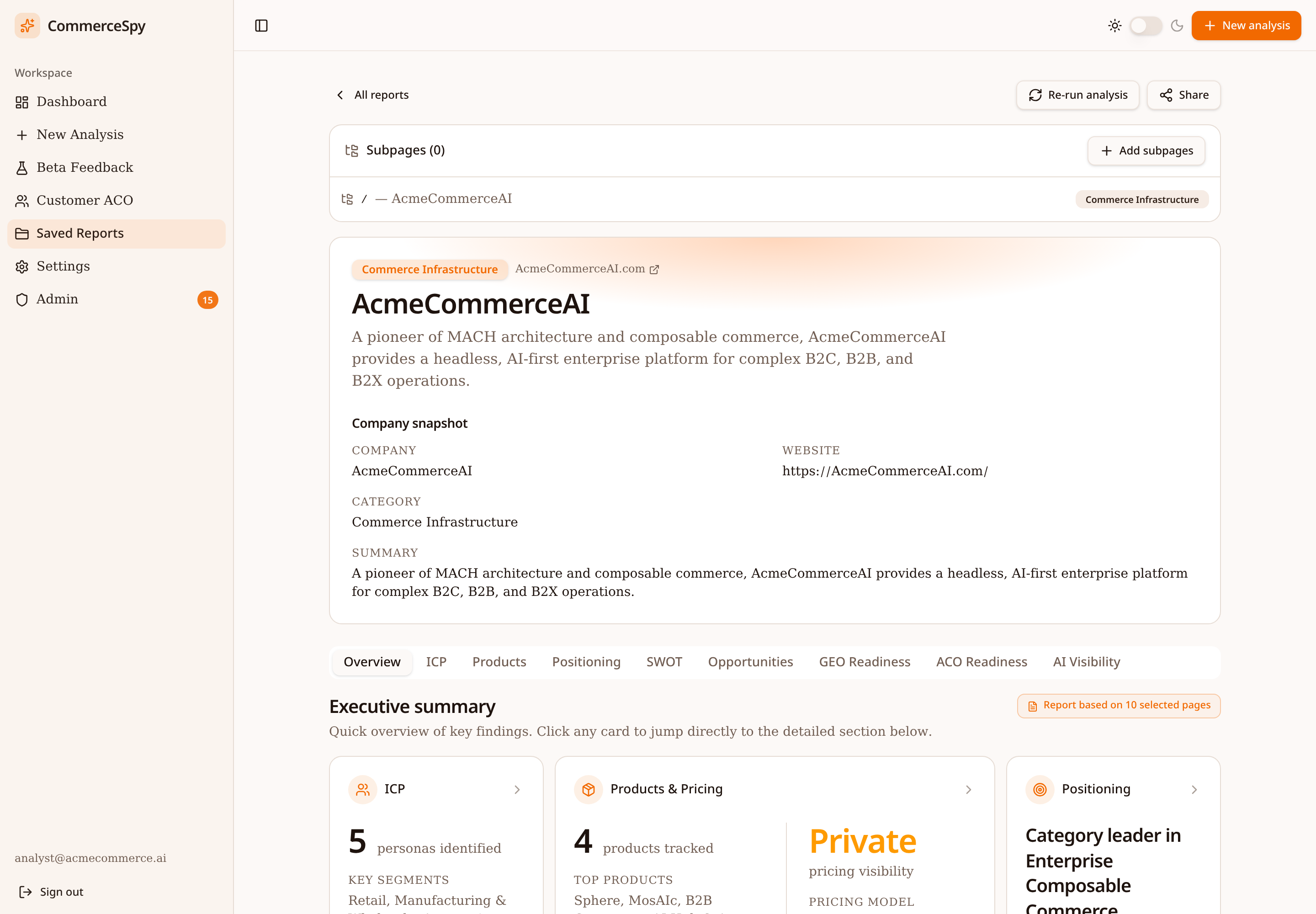
- 3CommerceSpy generates a structured report — ICP, products, pricing, positioning, SWOT, opportunities, GEO, ACO, and AI Visibility.
- 4Share the report internally, or with partners and clients, via a sharable link.
- 5Re-run to see a diff against the previous version — competitive intelligence becomes a cadence, not a one-off.
Summary
- Competitor research is a task; competitive intelligence is a workflow.
- Structured, repeatable inputs make strategic decisions defensible.
- Modern CI teams serve product, marketing, sales, and the executive team from the same source.
- CommerceSpy provides the structured report and diff cadence out of the box.
Frequently asked questions
- Is competitive intelligence the same as market research?
- No. Market research studies the market and buyers; competitive intelligence focuses specifically on competitors and how to respond to them.
- How often should competitive intelligence be updated?
- Most teams benefit from a monthly or quarterly cadence, with ad hoc updates when a competitor makes a material change (repositioning, pricing, acquisition).
- Who owns competitive intelligence inside a company?
- Ownership varies — product marketing, strategy, or a dedicated CI function. The consumer is always cross-functional: product, marketing, sales, and executives.
- Does competitive intelligence require paid data providers?
- Not necessarily. Public websites, product pages, pricing pages, and AI answer signals already provide most of the structured input CommerceSpy uses.
See it applied to a real vendor
CommerceSpy generates a structured intelligence report for any commerce technology company in minutes.
Start free analysisRelated resources
GEO Readiness
What is GEO Readiness?
A clear definition of GEO (Generative Engine Optimization), how it differs from SEO, and what commerce technology vendors should optimize first.
Read articleAI Visibility
What is AI Visibility?
How AI Visibility works, why it is now a distribution channel for software vendors, and how to measure and improve it.
Read articleAgentic Commerce
AI Is Changing Software Buying
How ChatGPT, Gemini, and other AI assistants are changing how buyers evaluate software, what it means for vendors, and where the trend is heading.
Read article