Competitive Intelligence
Why Every Commerce Software Company Needs Competitive Intelligence in the AI Era
Software companies no longer compete only on products and pricing. They also compete for visibility inside AI assistants, answer engines, and AI-driven buying journeys.
Traditional competitor research is broken
Most commerce software companies still research competitors the same way they did a decade ago. Someone opens a search engine, reads a few review sites, clicks through vendor websites, collects anecdotes from sales calls, and occasionally reads an analyst summary. The output is usually a slide or a spreadsheet that is accurate for about a week.
- Google searches surface marketing pages, not structured evidence.
- Review sites reflect a self-selected sample of customers.
- Vendor websites describe intent, not necessarily delivery.
- Sales calls capture fragments that rarely reach product or marketing.
- Analyst reports are thorough but expensive and infrequent.
The deeper problem is not the sources. It is the process. Manual research is slow, hard to repeat consistently, difficult to compare over time, and almost impossible to share across teams in a form anyone trusts.
AI has changed the buying journey
Buyers increasingly begin with an AI assistant rather than a search engine. They describe a problem to ChatGPT, Gemini, Perplexity, or an assistant embedded in the tools they already use, and they expect a shortlist in return. Vendor websites are now often the second or third stop, not the first.
That shift changes three things at once. Discovery moves from keyword matching to entity understanding. Shortlisting happens before a buyer identifies themselves. Vendor comparison is drafted by a model working from whatever public evidence it can find and interpret.
| Stage | Traditional journey | AI-assisted journey |
|---|---|---|
| Discovery | Search results and referrals | Model-generated category summary |
| Shortlisting | Buyer compiles a vendor list | Assistant proposes 3 to 5 vendors |
| Comparison | Website visits and demos | Model drafts the comparison first |
| Evidence | Sales collateral | Public, machine-readable content |
The practical consequence is uncomfortable but simple: a competitor can win the shortlist without ever outperforming you on product, purely by being easier for a model to understand and cite.
Modern competitive intelligence goes beyond competitors
Feature grids still have a place, but they answer a narrow question. Teams now need a broader view of how a competitor presents itself and how machines interpret that presentation.
- Positioning: the category a competitor claims and the buyer it addresses.
- Messaging: the language, proof points, and differentiators used publicly.
- Pricing: what is disclosed, what is gated, and what is deliberately vague.
- Product strategy: where investment and roadmap signals point.
- GEO Readiness: how well the site can be parsed and cited by answer engines.
- AI Visibility: whether assistants surface the vendor for relevant questions.
- AI Commerce Optimization: readiness for AI-driven and agentic buying journeys.
Read together, these dimensions explain not only what a competitor sells, but how likely they are to be found, understood, and recommended in the next twelve months.
Why this matters for every team
Founders
Competitive intelligence exposes where a market is consolidating, which positions are already crowded, and which segments remain underserved. It supports investment decisions with evidence rather than instinct.
Product managers
Structured monitoring makes competitor movement visible between releases: new modules, changed pricing tiers, shifted target segments, and quiet deprecations that signal strategy.
Marketing teams
Positioning improves when you can see the exact language competitors use. Overlapping claims are easy to spot, and genuinely distinct claims become easier to defend.
Sales teams
Competitive conversations go better when a rep knows the competitor's stated ICP, published pricing posture, and known weaknesses before the call rather than after it.
Agencies and consultants
Advisors are judged on the quality of their evidence. A repeatable analysis process shortens research time and makes recommendations easier for clients to accept.
The cost of not knowing
- Losing AI visibility: competitors are cited in answers while you are absent from them.
- Poor positioning: claims that sound distinctive internally but duplicate the category externally.
- Missed market shifts: pricing model or segment changes noticed a quarter too late.
- Product blind spots: roadmap decisions made without knowing what is already commoditized.
- Slow strategic decisions: every question triggers a new manual research cycle.
None of these failures announce themselves. They appear later as longer sales cycles, weaker win rates, and a pipeline that quietly shrinks at the top.
How CommerceSpy helps
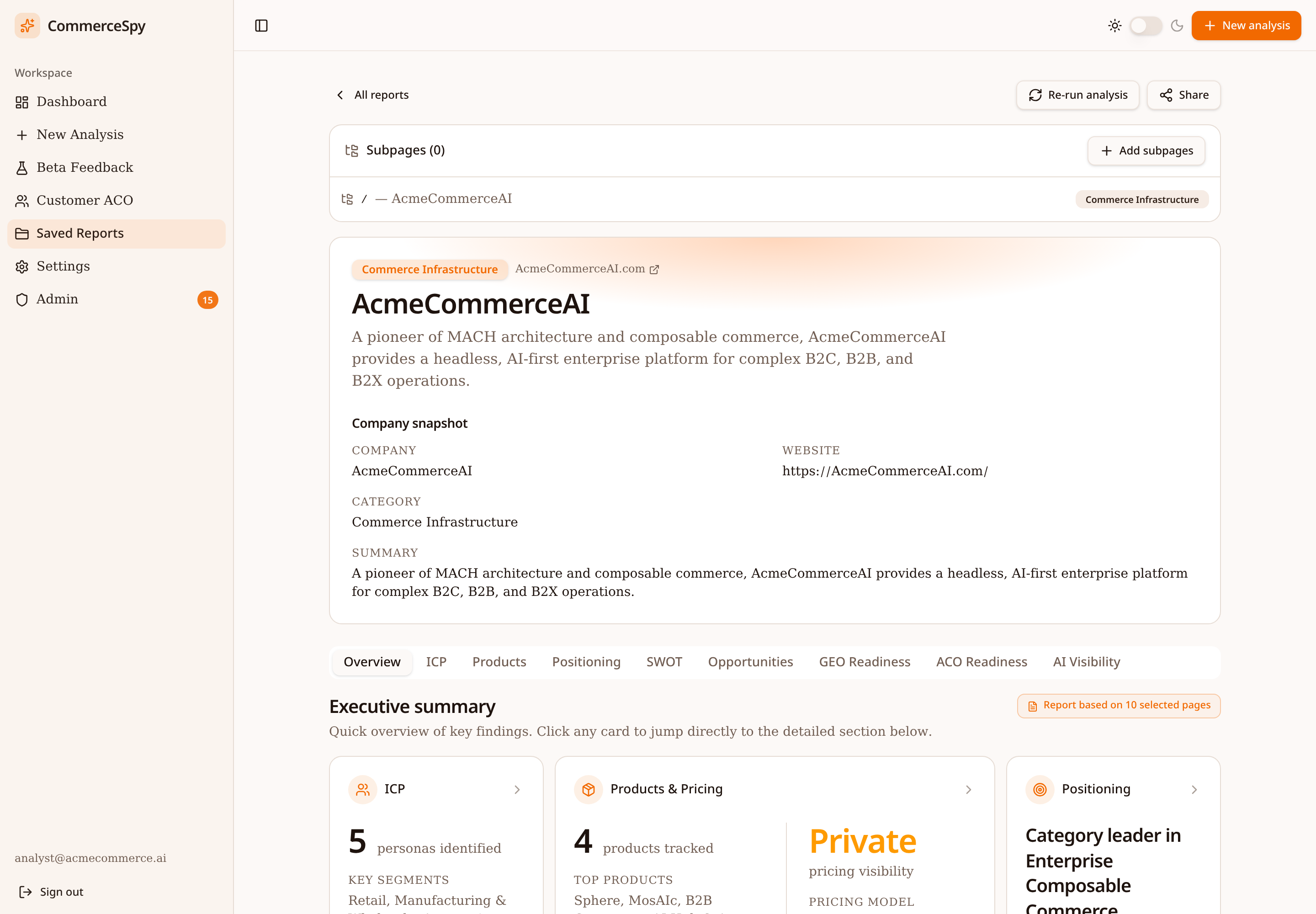
CommerceSpy turns public competitor content into a structured report. You provide a competitor URL, select up to ten relevant pages, and the platform analyses only that evidence. Nothing is inferred from pages you did not select.
- 1Competitor URL: choose the vendor and the pages that matter.
- 2Structured intelligence report: evidence-based sections generated from those pages.
- 3Competitive insights: positioning, gaps, and opportunities made explicit.
- 4Better strategic decisions: a shared basis for product, marketing, and sales choices.
Each report covers an Executive Summary, ICP, product analysis, pricing, positioning, SWOT, strategic opportunities, GEO Readiness, AI Visibility, and AI Commerce Capability. Where information is not publicly available, the report says so. Pricing that is not disclosed is reported as not publicly disclosed rather than estimated.
Real-world use cases
- Launching a new feature: check whether competitors already claim the capability and how they describe it.
- Preparing for a customer meeting: review a competitor's stated ICP and pricing posture before the call.
- Evaluating competitors: compare positioning across several vendors using the same structure.
- Planning a product roadmap: identify where the category is saturated and where it is thin.
- Improving AI discoverability: use GEO and AI Visibility findings to prioritise site changes.
Summary
- Manual competitor research is slow, inconsistent, and hard to share.
- AI assistants now shape discovery, shortlisting, and comparison.
- Modern intelligence covers positioning, pricing, GEO, AI Visibility, and AI Commerce Capability (ACO for vendors).
- Every commercial team benefits from the same evidence base.
- The goal is to move from reactive research to continuous competitive intelligence.
Frequently asked questions
- How often should competitor analysis be updated?
- For active competitors, a quarterly refresh is a reasonable baseline, with an additional run whenever a competitor changes pricing, launches a major product, or repositions. Comparing versions over time is often more valuable than any single report.
- Is competitive intelligence only useful for marketing?
- No. Marketing uses it for positioning, product for roadmap decisions, sales for competitive conversations, and leadership for investment choices. The value increases when all teams work from the same evidence.
- How is CommerceSpy different from SEO tools?
- SEO tools measure keywords, rankings, and backlinks. CommerceSpy analyses positioning, ICP, products, pricing, and readiness for AI-driven discovery, using the specific competitor pages you select as evidence.
- Can AI really improve competitor research?
- AI is effective at reading large volumes of public content and structuring it consistently. Its weakness is invention, which is why reports should be grounded in selected pages and should state clearly when information is unavailable.
- Who benefits most from competitive intelligence?
- Companies in crowded categories where buyers compare several similar vendors. In commerce technology that includes ecommerce platforms, personalization, loyalty, subscription, search and merchandising, and AI commerce tooling.
References
- 1Google Search Central documentation| Google
- 2AI Index Report| Stanford HAI
- 3The state of AI| McKinsey
- 4The gen AI playbook for organizations| Harvard Business Review
- 5Schema.org vocabulary| Schema.org
- 6OpenAI platform documentation| OpenAI
See more in the Resources centre, the platform overview, or the latest product updates. Questions? Contact the team.
See it in action
Generate a structured competitor intelligence report in minutes and discover how competitors position themselves, where they appear in AI, and where new opportunities exist.
Run a free analysisRelated resources
Competitive Intelligence
What is Competitive Intelligence?
The difference between competitor research and competitive intelligence, how modern teams use it, and how CommerceSpy structures the workflow.
Read articleAgentic Commerce
AI Is Changing Software Buying
How ChatGPT, Gemini, and other AI assistants are changing how buyers evaluate software, what it means for vendors, and where the trend is heading.
Read articleGEO Readiness
What is GEO Readiness?
A clear definition of GEO (Generative Engine Optimization), how it differs from SEO, and what commerce technology vendors should optimize first.
Read articleAI Visibility
What is AI Visibility?
How AI Visibility works, why it is now a distribution channel for software vendors, and how to measure and improve it.
Read article