Competitive Intelligence
The economics of better decisions in commerce software
Development, marketing and sales capacity is often committed on assumptions about competitors. CommerceInsights helps commerce software teams examine those assumptions against selected public evidence first, so the rationale behind each commitment is clear to product, commercial and finance reviewers alike.
3 free reports with a verified corporate email address.
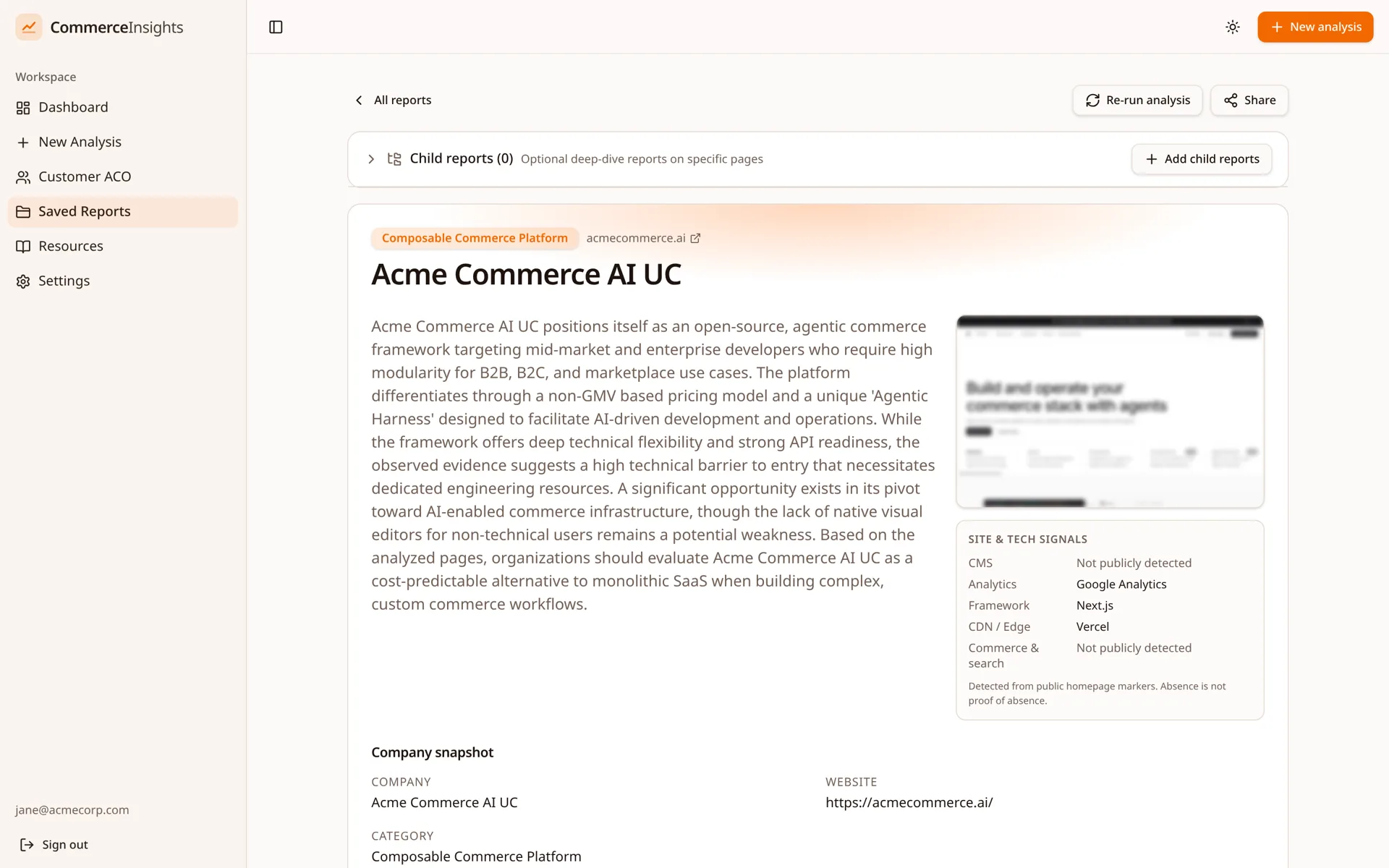
Roadmap bets, campaign plans and sales priorities often rest on beliefs about what competitors offer, who they target and how they position themselves. Those beliefs shape where capacity goes. Reviewing relevant public evidence before committing that capacity helps teams test their assumptions and see which questions still need validation.
Competitive evidence is one input. It sits alongside customer research, delivery estimates, technical evaluation and financial analysis, and works best when it informs those rather than replacing them.
Two economic costs
1. The cost of research effort
Gathering, reading and consolidating competitor websites by hand takes time from product, marketing and sales people whose capacity is limited. Repeating that work across several competitors and several times a year adds up, and the results are often hard to compare or share.
2. The cost of unsupported assumptions
When a decision rests on an assumption nobody checked, the consequences can include development capacity spent on a capability the market does not reward, messaging that misses how competitors actually position themselves, or sales teams meeting objections they did not anticipate. These costs are rarely visible in advance, which is why the evidence behind a commitment matters.
Three sources of value
- 1Research capacity: a consolidated report can reduce repetitive gathering and consolidation, leaving more time for interpretation and follow-up.
- 2Resource allocation: evidence can inform whether to proceed, narrow scope, defer or investigate a product or go-to-market initiative further.
- 3Shared decision context: stakeholders review the same documented claims, reasonable inferences and unknowns, rather than separate impressions.
Illustrative decision scenario
A product team is considering a €200,000 development initiative, partly because a competitor prominently promotes an AI capability. Before committing, the team selects relevant public pages from the competitor's site, such as product, solution, documentation and pricing pages, and generates a report.
The report separates what the competitor publicly claims from what can reasonably be inferred and what remains unknown. A published claim is not proof of a working capability, adoption or customer outcomes. Equally, finding no evidence on the selected pages does not prove a capability is absent.
The evidence does not decide whether the initiative should go ahead. It helps the team frame better questions and choose a sensible next step, which might look like this:
| Possible next step | Evidence that might point this way |
|---|---|
| Proceed | Claims appear specific and consistent across pages, and customer research separately confirms demand. |
| Narrow scope | Claims focus on a narrower use case than first assumed, which may suggest a smaller first release. |
| Defer | Claims are general or early stage, and other priorities have stronger supporting evidence. |
| Investigate further | Important questions remain unknown and need customer interviews, technical evaluation or a trial. |
In every case, the decision also depends on customer research, delivery estimates and financial analysis that sit outside the competitor report.
Research capacity calculator
Use your own assumptions to estimate how much research time a consolidated report might release. The result describes staff capacity, not a cash saving, and it does not include the cost of any tool.
Research capacity calculator
Compare the time your team spends researching competitors by hand with the time spent reviewing a generated report. Start from an example, then adjust to your own numbers. Nothing is submitted or stored.
Start from an example
Time to find, read and summarise a competitor's pages by hand. Often 2–8 hours.
Time to select pages, read the report and check sources. Often 0.5–1.5 hours (0.5 = 30 min).
Salary plus overheads per hour, in the selected currency.
Changes formatting only. No exchange rates are applied.
3.5 h saved per review (88% less time). Across 16 reviews a year, that is 56 hours, worth about €4,200 of staff time.
- Manual research hours per year
- 64
- Assisted research hours per year
- 8
- Hours released per year
- 56
- Value of released time
- €4,200
How it works: competitors × reviews per year × hours per review. Hours released = manual minus assisted. Value = hours released × hourly cost. Released time can be redirected to analysis and follow-up; it is not a cash saving or ROI figure.
From evidence to action
- 1Selected public pages: choose up to 25 relevant pages from a competitor's website. Only those pages are used as evidence. Selection is not independent verification.
- 2Grounded synthesis: the report summarises the selected sources and labels observed facts, reasonable inferences and unknowns. Review it like any analysis; accuracy is not guaranteed.
- 3Stakeholder review: product, marketing, sales and finance reviewers look at the same evidence and identify open questions.
- 4Further validation and decision: open questions are tested through customer research, technical evaluation or trials before capacity is committed.
Reports are re-run manually when you want a fresher view, and versions can be compared. CommerceInsights does not monitor competitors continuously or send automated alerts.
Practical evaluation
If you want to compare manual and assisted research, keep the comparison fair:
- Use equivalent scope: the same competitor, the same questions and the same set of pages or sources.
- Agree quality criteria in advance: completeness, traceability to sources and usefulness for the decision at hand.
- Account for familiarity: repeating the same task can favour the second attempt, because the researcher already knows the material. Where practical, use different competitors of similar complexity or different people for each approach.
- Measure the full assisted effort, including page selection, reading the report, checking sources and writing conclusions.
- Assess time alongside completeness, traceability and usefulness, rather than time alone.
GEO Readiness, AI Visibility and AI Commerce Capability are assessed separately in each report, and Customer ACO is a separate assessment of merchant sites. These indicate readiness and visibility signals. They are not predictions of pipeline, revenue or won deals.
Frequently asked questions
- Does this replace analysts or researchers?
- No. It aims to reduce repetitive gathering and consolidation so people can spend more time on interpretation, validation and decisions.
- Are the selected pages verified?
- No. Reports use the public pages you select as evidence. What a competitor publishes is reported as a claim, not as independently proven capability or adoption.
- What if a capability is not found in the report?
- Absence of evidence on the selected pages is not proof that a capability does not exist. Treat it as an unknown and validate it another way if it matters.
- Is the calculator an ROI estimate?
- No. It estimates research hours and the value of that staff capacity under your assumptions. It does not calculate net savings or return on investment.
- Does CommerceInsights monitor competitors continuously?
- No. You re-run an analysis when you want an updated view and can compare report versions.
- What does it cost?
- Pricing not publicly disclosed. New accounts with a verified corporate email address start with 3 free reports, and you can contact us about additional reports.
See what an evidence-grounded report looks like
Open the sample report to see how claims, inferences and unknowns are presented, or start with 3 free reports using a verified corporate email address.
Start free analysisRelated resources
Competitive Intelligence
Why Every Commerce Software Company Needs Competitive Intelligence in the AI Era
Why traditional competitor research is no longer enough, how AI has changed software buying, and what structured competitive intelligence looks like for commerce technology vendors.
Read articleCompetitive Intelligence
What is Competitive Intelligence?
The difference between competitor research and competitive intelligence, how modern teams use it, and how CommerceInsights structures the workflow.
Read articleAI Commerce Optimization
What is AI Commerce Optimization (ACO)?
A working definition of AI Commerce Optimization, why it matters as agentic commerce emerges, and how CommerceInsights scores vendor AI Commerce Capability.
Read article