AI Commerce Optimization
What is AI Commerce Optimization (ACO)?
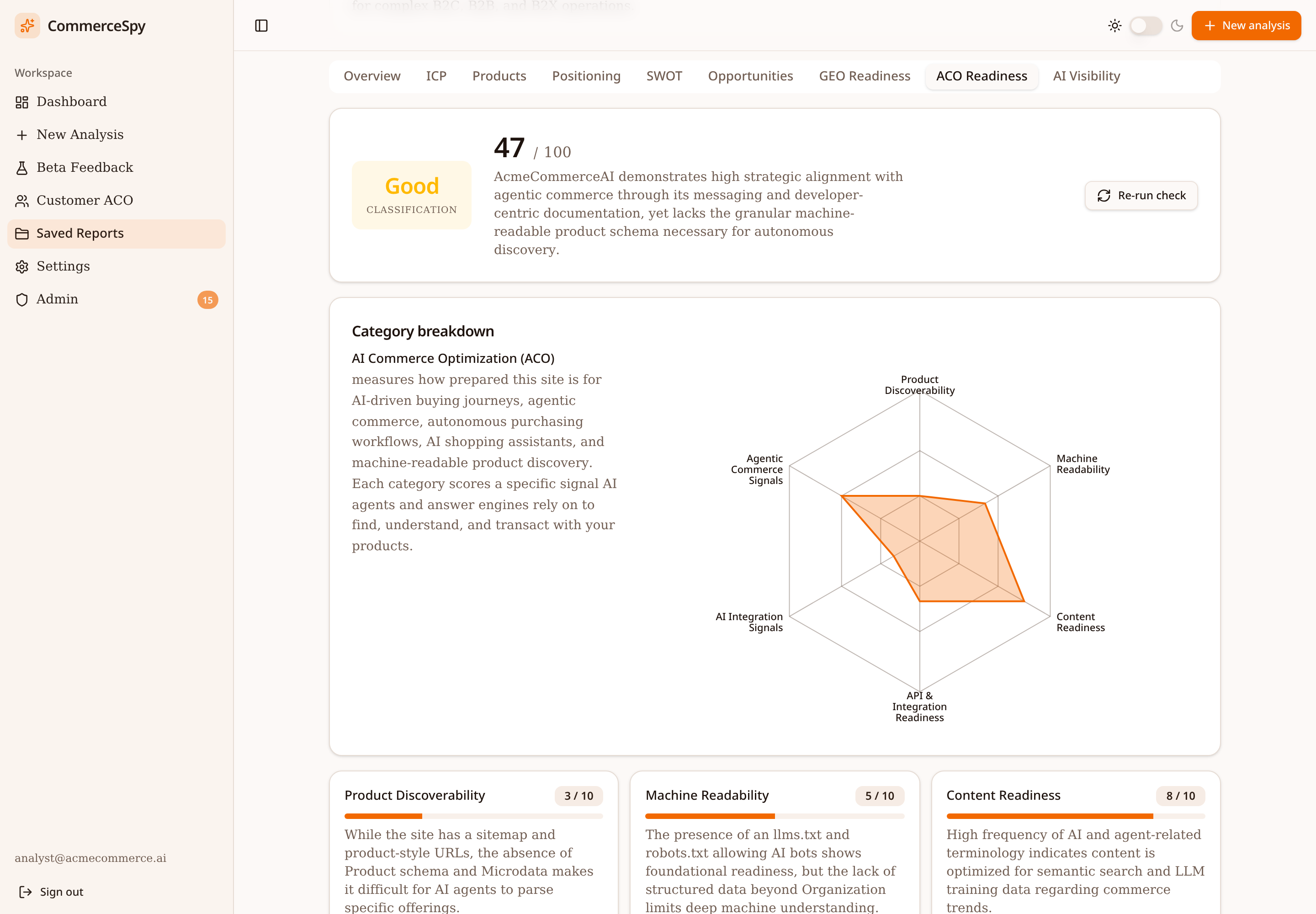
ACO is the practice of preparing a commerce vendor's product surface so that AI agents can understand, compare, and transact against it.
What is AI Commerce Optimization?
AI Commerce Optimization (ACO) is the practice of preparing a commerce vendor's product surface — website, catalog, pricing, integrations, and APIs — so that AI agents can reliably discover, evaluate, and transact against it. Where GEO focuses on being understood by AI answer engines, ACO focuses on being usable by AI systems that take action.
Relationship to AI-driven buying journeys
In an agentic commerce world, an AI acts on behalf of the buyer. It compares products, evaluates fit, and — increasingly — completes the purchase. Vendors whose product data is inaccessible, ambiguous, or trapped behind human-only UI will be skipped in favor of vendors the agent can transact against.
Machine-readable commerce
- Product data available as structured feeds or APIs, not only rendered HTML.
- Consistent identifiers across catalog, pricing, and inventory.
- Standards-based schemas (schema.org Product, Offer, AggregateRating).
- Clear pricing and availability signals AI can quote confidently.
Structured product information and APIs
The strongest ACO signals come from actual programmable surfaces. Public product APIs, documented integrations, and predictable data shapes make it possible for AI systems to reason about the vendor without scraping. Vendors that publish a real developer surface score higher on ACO Readiness.
Product discoverability
Discoverability spans both humans and machines. For humans it is category pages, search, and merchandising. For machines it is feeds, schema, and open documentation. Vendors that invest in only one side are increasingly at a disadvantage.
AI integration signals
- Public documentation for MCP, plugins, or agent-facing capabilities.
- Documented webhooks and event streams.
- Clear terms for programmatic access and rate limits.
- Explicit statements about AI compatibility on the developer site.
How CommerceSpy evaluates ACO Readiness
CommerceSpy scores ACO Readiness on a 0-100 scale using an evidence-based checklist. Each report includes an overall classification (Emerging, Fair, Ready, Advanced), a category breakdown across the ACO signals above, and specific opportunities to improve the vendor's agent-readability.
Summary
- ACO prepares a commerce vendor to be used by AI agents, not just found by them.
- Machine-readable product data, APIs, and integration signals are the core building blocks.
- Vendors that ignore ACO risk being routed around in agent-driven buying journeys.
Frequently asked questions
- How is ACO different from GEO?
- GEO makes a vendor understandable to AI answer engines. ACO makes a vendor usable by AI agents that take action — comparing, integrating, or transacting.
- Do you need public APIs to score well on ACO?
- Public APIs materially raise the ceiling, but a vendor can score reasonably with strong structured data, documented integrations, and clear commerce metadata even before opening a full API.
- Is ACO only relevant to ecommerce merchants?
- No. It is especially relevant to the software and technology vendors that serve merchants — those vendors' products are increasingly being evaluated and integrated by AI agents.
- How is ACO Readiness scored in CommerceSpy?
- 0-100 with a classification (Emerging, Fair, Ready, Advanced), plus a category breakdown so teams can see which ACO signals to invest in first.
See it applied to a real vendor
CommerceSpy generates a structured intelligence report for any commerce technology company in minutes.
Start free analysisRelated resources
GEO Readiness
What is GEO Readiness?
A clear definition of GEO (Generative Engine Optimization), how it differs from SEO, and what commerce technology vendors should optimize first.
Read articleAI Visibility
What is AI Visibility?
How AI Visibility works, why it is now a distribution channel for software vendors, and how to measure and improve it.
Read articleAgentic Commerce
AI Is Changing Software Buying
How ChatGPT, Gemini, and other AI assistants are changing how buyers evaluate software, what it means for vendors, and where the trend is heading.
Read article