AI Visibility
What is AI Visibility?
AI Visibility measures whether AI assistants mention, recommend, or cite a vendor when buyers ask category-defining questions.
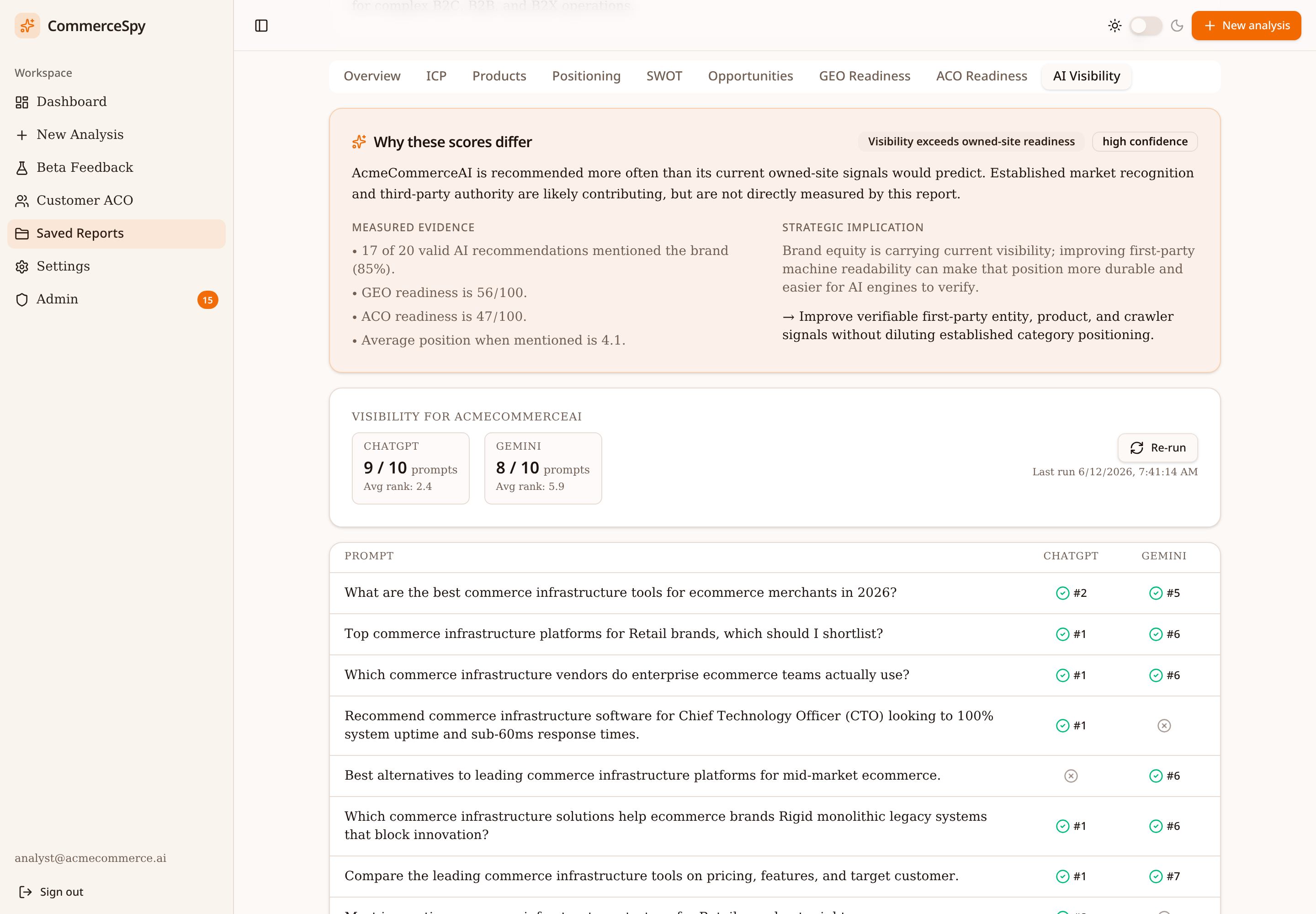
What is AI Visibility?
AI Visibility is the share of relevant AI assistant answers in which a vendor is mentioned, cited, or recommended. It is measured by running realistic buyer prompts against major AI answer engines and checking whether the vendor appears — and in what position.
AI Visibility is downstream of GEO Readiness. GEO Readiness measures the signals a site emits; AI Visibility measures the outcome — what the AI engines actually say.
Why appearing in ChatGPT and Gemini matters
- AI assistants are the new top-of-funnel for software research.
- Being recommended by an AI is a strong trust signal for the buyer.
- A vendor that consistently appears in relevant answers effectively owns share of the AI-mediated buying journey.
- Vendors that never appear are invisible before the buyer ever visits a website.
How buyers research software today
Modern B2B buyers commonly use an AI assistant to shortlist vendors, summarize categories, compare products, and generate objections before speaking to sales. The vendor that appears in that shortlist has already won attention that competitors never see.
An example
Consider a marketing director asking: "What are the best subscription platforms for a European DTC brand with 50,000 subscribers?" An AI assistant will typically respond with 3-6 named vendors, sometimes with short pros and cons. Every vendor in that list has AI Visibility for that prompt. Every vendor absent has zero — regardless of how many G2 reviews they have.
How CommerceSpy measures AI Visibility
CommerceSpy generates realistic buyer prompts for the vendor's category and runs them against major AI answer engines. For each prompt, we record whether the vendor was mentioned, its position, and which competing brands were mentioned alongside it. The result is a visibility score, a per-prompt breakdown, and a competitive gap view.
How to improve AI Visibility
- 1Improve GEO Readiness — clearer facts and stronger schema make the vendor easier to cite.
- 2Publish authoritative category content the AI can quote — definitions, comparisons, methodologies.
- 3Earn third-party mentions on sites the AI engines rely on for training and retrieval.
- 4Keep product and pricing pages accurate, current, and self-contained.
- 5Ensure the brand name, category, and target audience are unambiguous across the site.
Summary
- AI Visibility is the share of AI answers that mention or recommend a vendor.
- It is measurable — run realistic prompts and record mentions and positions.
- GEO Readiness improvements typically drive AI Visibility improvements over time.
- Missing from AI answers means invisible to a growing share of buyers.
Frequently asked questions
- How is AI Visibility different from GEO Readiness?
- GEO Readiness measures signals emitted by your website. AI Visibility measures actual outcomes — whether AI assistants mention your brand in relevant answers.
- Which AI engines does CommerceSpy check?
- CommerceSpy runs prompt checks against major generative AI answer engines, including ChatGPT and Gemini. Coverage expands as engines mature.
- Can AI Visibility be gamed?
- Not directly. Answers come from the model's training and retrieval. The reliable path is stronger signals: clear definitions, authoritative content, and consistent third-party mentions.
- How often should we measure AI Visibility?
- Quarterly is a reasonable baseline; monthly makes sense during active launches or repositioning. AI answers shift as models are updated and content is re-indexed.
See it applied to a real vendor
CommerceSpy generates a structured intelligence report for any commerce technology company in minutes.
Start free analysisRelated resources
GEO Readiness
What is GEO Readiness?
A clear definition of GEO (Generative Engine Optimization), how it differs from SEO, and what commerce technology vendors should optimize first.
Read articleAgentic Commerce
AI Is Changing Software Buying
How ChatGPT, Gemini, and other AI assistants are changing how buyers evaluate software, what it means for vendors, and where the trend is heading.
Read articleCompetitive Intelligence
What is Competitive Intelligence?
The difference between competitor research and competitive intelligence, how modern teams use it, and how CommerceSpy structures the workflow.
Read article